Friday, March 15, 2013


home-loan2 (1)
The Income Tax Act provides a separate head for tax of ‘Income from House Property’ under Section 22 to Section 27.
Interest paid or payable on money borrowed for the purchase, construction, repair, or reconstruction of a house is allowed as a deduction. In case of a self-occupied property treated as such, the maximum deduction will be Rs 30,000 per annum.
If the funds have been borrowed for the acquisition or construction of a house after 1 April 1999, Rs 1.50 lakh will be deductible.
Source:TNN

With the introduction of this offer, consumers get the benefit of converting the entire amount on the credit card into interest free installment.
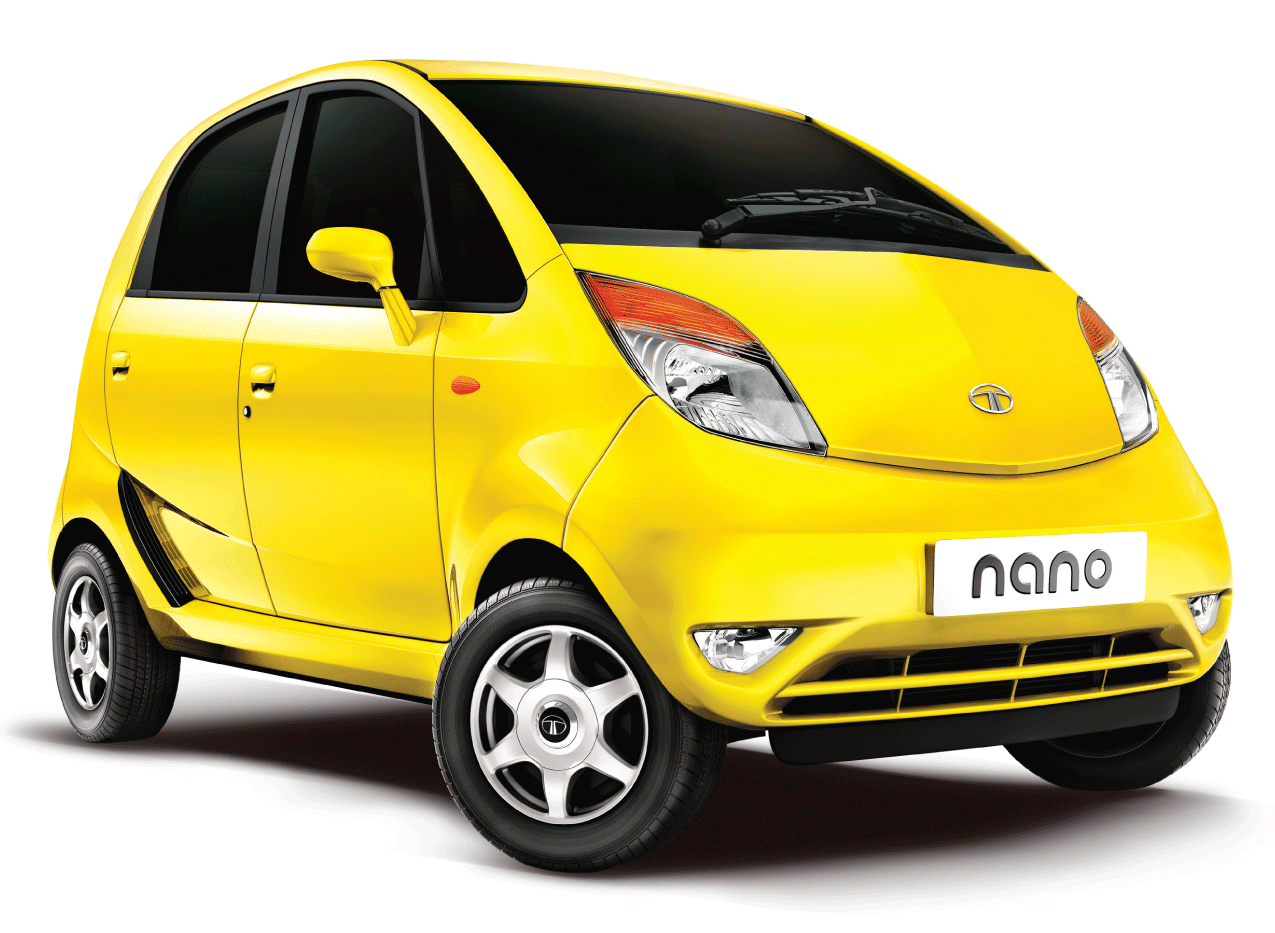
MUMBAI: In a first of its kind deal in the Indian automobile industry, Tata Motors BSE -1.84 % on Wednesday in a bid to jumpstart flagging sales of TataNano has offered customers an option to swipe their credit card and drive out with the Tata Nano on the same day.
tata_nano_launch
Ranjit Yadav, president, Passenger Vehicles Business Unit, Tata Motors said: “This offer will enable customers to own a car in the fastest and hassle free manner. With the introduction of this offer, consumers get the benefit of converting the entire amount on the credit card into interest free installment, spread over a period of 12 months and manage monthly cash flow better.”
When Yadav, a recent hire at Tata Motors joined India’s largest automobile firm from Samsung India- the South Korean consumer electronic major’s Indian subsidiary in September 2012, it was speculated that the automobile industry that lacks innovative methods to sell products could take a leaf from the fast moving consumer electronics business.
This is precisely what Yadav, the former country head at Samsung (India) for the Mobile & IT Businesses brought to the table, by offering an option to customers to buy a vehicle through a credit card, the same way a mobile phone or a lap top is bought. Source:ET
Consumer Voice http://ow.ly/iy9YT

Tuesday, March 5, 2013


Indians are increasingly taking to smartphones and the number of such devices in the country touched 40 million last year with almost half of the users younger than 25, says a survey.The dramatic growth in the usage of smartphones is driven by a desire among users to stay connected and have instant access to social networking sites, according to the survey by research firm Nielsen.
"Decreasing device and data costs, coupled with a wide range of features that today's smartphones offer, readily encourage consumers to trade in their traditional cell phones for handsets with much more functionality," the survey said.
According to the Indian smartphone user study – conducted in September and October 2012 across 46 cities – people overwhelmingly prefer mobile devices that operate on the Android operating system.
While Symbian usage is also high in India, Windows, BlackBerry and iOS devices each only have single-digit market shares, said Nielsen Informate Mobile Insights that polled more than 10,000 smartphone owners.
Moreover, tablet ownership among Indians is set to spike as consumer interest in tablets is also on the rise.
While only 3 per cent of respondents who participated in the study in the last quarter of 2012 said they owned a tablet, 11 per cent said they intended to purchase one.
Voice calls and texting accounted for only 25 per cent of smartphone usage; multimedia, games, apps and Internet browsing made up the rest.
Among apps, consumers prefer games, particularly with respect to paid apps. Games were the most popular category among paid apps, with nearly three out of five users (58 per cent) paying for games.

Friday, February 22, 2013


When you buy goods or services, the law protects your rights as a consumer. However, instances of purchases going wrong are reported routinely enough.

In an ideal world, we all would want redress for our grievances. To begin with, though, the way ahead may seem intimidating and even confusing.

At that point, when you need the counsel of someone you can trust – or perhaps simply the first few pointers and a gesture of encouragement – you can simply turn to Consumer Voice.

To start receiving your copy of Consumer Voice
you may call on 011-47331002/3 
You can also log on to 

Thursday, February 14, 2013

With consumer spending expected to grow four times, 
international brands can't ignore India, says study


Irrespective of the global economic slowdown, the luxury market in India is pegged to grow at 25% on a year-on-year basis between 2013 and 2015. And it may be worth Rs 82,500 crore ($15 billion) from the current level of Rs 44,000 ($8 billion), reveals the Assocham-Yes Bank study. 
“The luxury market is poised to expand three fold in next three years and the number of millionaires expected to multiply three times in another five years.
Globally also consumer spending is rising, and is expected to reach Rs 2,200 lakh crore ($40 trillion) by 2020 with an unprecedented growth of Rs 660 lakh crore ($12 trillion) in a decade.
Predictable consumer spending patterns beyond geographies and cultures unwrap possibilities of future growth in emerging markets like India where consumer spending is expected to grow four times to Rs 198 lakh crore ($3.6 trillion) within this period, driven by increasing income and aspirations, adds the paper.
Indian luxury market is projected to reach Rs 808.50 lakh crore ($14.7 billion) in 2015. The number of Ultra High Networth Households, with a minimum net worth of Rs 25 crore is expected to triple to 2.86 lakh in next five years with a five-fold increase in their net worth to Rs 235 trillion. And the HNIs will be double in number by 2015 to over 4 lakh.
The Private Equity (PE) investments in the luxury sector for the last three years, that is, January 2009 - August 2012 have been less than Rs 5,500 crore ($1 billion) compared to the Rs 1,925 crore ($35 billion) total PE investments during this period. With the luxury market expected to grow, PE investments in the segment are also expected to increase. There are a number of funds in India, which are focussed on investing in consumer centric businesses, from Everstone, L Capital and Avigo.
India and China have shown their resilience to the global turmoil by exhibiting sustained growth and thus laying a solid foundation for future global economic recovery. A reflection of this can be seen in the potent demand being witnessed by global luxury brands from these emerging economies. As elite members of the BRIC club, which currently accounts for 11% of the total world luxury sales, India and China are poised to take dominant positions in the global luxury market.
While China is on track to become the world’s second largest luxury market within the next five years, India too is not far behind.
While various estimates exist on the size and growth potential of the Indian luxury market -  most estimates align on anticipated growth rates of 20% given the tremendous potential waiting to be harnessed by such products: Apparel and Accessories, Pens, Home Décor, Watches, Wines & Spirits & Jewelry, services: Spas, Concierge service, Travel & Tourism, Fine Dining & Hotels and assets: Yachts, Fine Art, Automobiles & Real Estate.
The best returns would come from investing in luxury assets for the long term and luxury products in the short term. Cars have shown the highest growth rate in luxury assets of 40% a year from 2006, driven by a wider choice of brands, availability of cars in the small and mid segment as well as rapid increase in millionaires in Tier I & II cities. It is estimated that luxury assets are going to grow to Rs 43,450 crore ($7.9 billion) in 2015 compared to Rs 23,705 crore ($4.31 billion) currently.
Luxury products are projected to grow to Rs 29,590 crore ($5.38 billion) in 2015 against the current Rs 15,675 crore $2.85 billion). Jewellery is believed to be the largest contributor (31%) for this sub-sector, driven by the investment mentality of Indians in jewellery which leads to low consumer price elasticity.
“Recent trends indicate a shift in the perception of luxury as an overall experience versus a mere material possession. This is evident from data on the Indian luxury services market which has shown resilience in the face of a global slowdown. The sector is expected to grow to Rs 7,975 crore ($1.45 billion) in 2015 from Rs 5,775 crore ($1.05 billion) currently. Hotels are the largest growth contributor.
Indian luxury market is a potential gold mine for international luxury brands. However, with every opportunity comes the accompanying challenges and India is no different. With thorough market research, prudent marketing strategies and the right local partner, global luxury players can unearth the sea of opportunities that India represents.

Sunday, February 3, 2013


Fast food giant McDonald's has been directed by a consumer forum in New Delhi to pay Rs 15,000 as compensation to one of its customers for delivering a non-veg burger instead of the vegetarian one she had ordered.

Fast food giant McDonald's has been directed by a consumer forum in New Delhi to pay Rs 15,000 as compensation to one of its customers for delivering a non-veg burger instead of the vegetarian one she had ordered.

The South West District Consumer Disputes Redressal Forum said, "By delivering her a non-vegetarian burger instead of the vegetarian burger ordered by her is a gross negligence on the part of the delivery crew-member, whose conduct is tantamount to deficiency-in-service. Allowing the complaint, we direct the opposite party (McDonald's) to pay to the complainant Rs 10,000 as compensation and Rs 5,000 as cost of litigation," the bench presided by Narendra Kumar said.

The woman had also alleged that being an Arya Samaj follower and a Hindu, eating the non-vegetarian food has hurt her emotionally and she also suffered religiously. In its defence, the McDonald's had contended that the woman had wilfully accepted the non-veg burger instead of the vegetarian one ordered by her.

The forum, however, rejected the contention, saying had she wanted a non-veg burger she would have ordered one.

The order came on the plea of Delhi resident Vimal Chaudhary who had alleged that she had ordered for two vegetarian burgers, but she was delivered one non-vegetarian and one vegetarian burgers. She had said that she realised it was a non-veg burger only after eating half of it and thereafter, she had started vomiting.

Friday, February 1, 2013


Come November and December, and many of you will be worrying about tax deductions. It’s a fact that many salaried individuals in India end up paying a lot of tax because they are not aware about the various available options available to them. However, if you will make an effort to understand the ways to reduce tax and plan the same ahead of time, you will not have much to fret about.

The plans may vary for different persons depend on the financial status and income. Here are the tax slabs for male and female as per income tax law: 
Income Tax Slabs 2011-2012 for Male and Female
Income
Tax Rate
Upto 2.0 Lakhs
NO TAX
2.0 Lakhs to 5 Lakhs
10%
5 Lakhs to 10 Lakhs
20%
Above10 Lakhs
30%
Income Tax slabs 2011-2012 for Senior Citizen (Between 60 Yrs and 80Yrs)
Income
Tax Rate
Upto 2.5 Lakhs
NO TAX
2.5 Lakhs to 5 Lakhs
10%
5 Lakhs to 10 Lakhs
20%
Above 10 Lakhs
30%
 Tax Exemptions
1) Section 80 C Limit Unchanged (Rs. 100,000)
Deduction on life insurance policy, taken after 1 April 2012, will be allowed only if yearly premium is less than 10% of sum assured. This is a new change from c.y. earlier it was 20%. If it is more than 10%, one is not eligible for deduction u/sec. 80C
·  ELSS
·  PPF
·  EPF
·  FD for 5 years
·  Pension Plans
·  NSC
·  Post Office SB
·  Infrastructure Bonds
·  Expenditure on Children Education (Up to Rs. 200 per month for up to 2 children)
·  Tuition fees (Only Tuition fees excluding Development Fees, Donations, etc. Maximum allowed: Rs. 24,000)
·  Housing loan principal
·  Deferred Annuity
·  Approved Super Annuation Fund
2) Section 80 CCF – Additional Rs. 20,000 on investments towards approved Infrastructure bonds - (withdrawn)
3) Section 80CCD:
Deduction under this section can be claimed only if the contribution to your NPS account is made by your employer and the deduction is limited to a maximum of 10% of your basic salary. Returns on NPS are tax free, but withdrawal is still taxable. The deduction under sec 80CCD is over and above the deduction available under sec 80C.
4) Section 80 D 
Deduction of Rs. 15,000 is allowed if the same is paid as premium for Medical Insurance taken for self/dependents or towards preventive health check-up (max Rs. 5,000). In case any of self/dependents is a senior citizen, the deduction allowed is Rs. 20,000.
Additional Rs. 15,000 is allowed as deduction if the same is paid as premium for Medical Insurance taken for parents. In case the parent is a senior citizen, the deduction allowed is Rs. 20,000.
5) Section 80DD 
Exemption given for Expenditure made for a disabled dependant towards Medical Treatment/Training/Rehabilitation. It also includes the LIC/Insurance premium paid towards maintenance of such dependant.
Maximum deduction allowed is Rs. 50,000 in case of normal disability and Rs. 1 lakh in case of severe disability.
6) Section 80DDB 
Exemption given for expenditure incurred on specified disease or ailments such as cancer/aids. Maximum deduction allowed is Rs. 40,000. In case of Senior Citizens, maximum deduction allowed is Rs. 60,000.
7) Section 80E 
Deduction is allowed for repayment of interest component of Higher Education loan. All education after Class 12 is allowed, either vocational or Fulltime. But should be from a school/institute/university recognized by the government.
8 ) Section 80G - Contribution to exempt charities – 25/50/75/100% depending on the charity and as per approval 100% exemption on donation to political parties
9) Section 80U 
Deduction up to Rs. 50,000 is allowed in case of Permanent Disability.
In case of Permanent Disability exceeding 80%, maximum deduction allowed is Rs. 100,000.
10) Section 24(1)(vi)
Housing loan interest. Maximum Investment Limit – Rs. 150,000 (for loans taken after 1 April 1999, for loans before that Maximum Investment Limit 30,000).
11) Superannuation – Any contribution made by a company to superannuation fund up to Rs. 100,000 tax free in the hands of the employee.
12) Conveyance/Transport Allowance – Any Conveyance / Transport Allowance given to an employee is tax free up to Rs. 9,600 (No Supporting Bills required).
13) Medical Allowance – Any Medical Allowance given to an employee is tax free up to Rs. 15,000 (Supporting Bills required).
14) HRA – Any House Rent Allowance given to an employee is tax free up to the minimum value of the following conditions (subject to – when an employee can produce rent paid receipts from landlord for the period and if the employee has not availed of tax exemptions for home loan interest / principal repayment):
a) 50% of Annual Basic (40% of Annual Basic in case of non-metros)
b) Actual HRA received
c) Rent Paid – (10% of Annual Basic)
15) Professional Tax – Any Professional Tax deducted from an employee’s salary can be reduced from the annual salary income to arrive at taxable salary.
16) Provident Fund – Provident Fund contributions (under section 80 C and subject to an overall investment limit of Rs. 100,000 ) deducted from an employee’s salary are tax exempt.
17) 80CCG – Direct Equity Investment – Under ‘Rajiv Gandhi Equity Savings Scheme‘ – a new equity investor will be able to claim 50% of his investment in direct equity as deduction subject to maximum investment of Rs. 50,000 and provided his taxable income is below Rs. 10 lakhs. The investment will be subject to 3 years lock-in. 
Update 23 Sep 2012: Government has notified this scheme (RGESS). Mutual funds and ETFs that invest in BSE100 or CNX 100 stocks or PSUs which are Navratna, Maharatna and Miniratna will qualify under this scheme. These investments can be traded over stock exchange after 1 year of investment. New equity investor has been defined as someone who has opened a Demat account but has not bought any securities till date of notification of this scheme (22 Sep 2012).
18) Section 80TTA – Savings Bank Interest - No tax will be charged on interest earned on balance in savings bank account subject to a maximum of Rs. 10,000 per year.

Friday, January 18, 2013


ONLY BUY OR FILL UP YOUR CAR OR BIKKIE IN THE EARLY MORNING WHEN THE GROUND TEMPERATURE IS STILL COLD. Remember that all service stations have their storage tanks buried below ground. The colder the ground, the denser the fuel, when it gets warmer petrol expands, so buying in the afternoon or in the evening.... your litre is not exactly a litre.

WHEN YOU'RE FILLING UP, DO NOT SQUEEZE THE TRIGGER OF THE NOZZLE TO A FAST MODE. If you look, you will see that the trigger has three (3) stages: low,
middle, and high. In slow mode, you should be pumping on low speed, thereby minimizing the vapours that are created, while you are pumping. All hoses at the pump have a vapour return. If you are pumping on the fast rate, some of the liquid that goes to your tank becomes vapour. Those vapours are being sucked up and back into the underground storage tank so you're getting less worth for your money.

ONE OF THE MOST IMPORTANT TIPS IS TO FILL UP WHEN YOUR TANK IS HALF FULL. The reason for this is, the more fuel you have in your tank, the less air occupying its empty space. Petrol evaporates faster than you can imagine. Petroleum storage tanks have an internal floating roof. This roof serves as zero clearance between the petrol and the atmosphere, so it minimizes the evaporation.

ANOTHER REMINDER, IF THERE IS A FUEL TRUCK PUMPING INTO THE STORAGE TANKS, WHEN YOU STOP TO BUY, DO NOT FILL UP - most likely the petrol/diesel is being stirred up as the fuel is being delivered, and you might pick up some of the dirt that normally settles on the bottom.
Hope, this will help you get the maximum value for your money.

DO SHARE THESE TIPS WITH OTHERS! LET’S SHARE INFORMATION AND BENEFIT ALL, FOR THE BETTER OF MANKIND.


Saturday, January 12, 2013


There was a time when only the affluent and the salaried scurried to neighbourhood malls for groceries. That time will soon be history, suggests a Nielsen India survey. Pretty soon, two growing shopper segments - low-income value explorers, or LIVE, and first-time modern trade shoppers (FTMTS) – will fuel growth of modern retail and fast-moving consumer goods (FMCG) companies, and hence receive the latter’s attention (which will also be on rural consumers).

For, the two new segments will add $3 billion (Rs16,638 crore) in consumer good sales by 2015. Adrian Terron, executive director of Nielsen India, says that half of the LIVE households have already migrated to branded products.

Some 5% of LIVE consumer spend is hogged by modern trade now. It is expected to reach $175 million (Rs971 crore) by 2015 as several of them go for bulk, larger and combo packs.

Luring FTMTS can also pay handsome dividends for FMCG companies and retailers as this segment is known to be prone to impulsive shopping, buying more than they had planned, said Terron.

To encourage consumers to buy more, focus will be on in-store activities.

So, differentiated promotional exercises will increase. "As a result, apart from goods, we will see more services forming a part of modern retail. For example, we could see additions such as hair salon, laundry service and so on in the departmental stores," said Terron.

Thursday, November 29, 2012