Wednesday, November 15, 2017


‘Man bleeds to death on Delhi road after hit and run case’ or ‘Accident victim left to bleed and die in Kerala's Thiruvananthapuram’ these are a few headlines that we get to read almost every day. Other than rash and negligent driving and not following traffic rules, one of the main reasons for high rate of road accident deaths in India is the inability of the victims to receive timely medical attention. The Law Commission of India Report of 2006, states that ‘at least 50 per cent of the fatality can be averted if the victims are admitted to a hospital within the first one hour.’ A World Health Organisation (WHO) report also states that ‘even the most sophisticated and well equipped prehospital trauma care system can do little if bystanders fail to recognize the seriousness of a situation, call for help and provide basic care until help arrives.’

A major impediment to victims getting timely help is the panic among bystanders that they could get entangled in legal procedures. This is the reason why a ‘Good Samaritan’ legal protection is essential. Though the Parliament hasn’t passed any such law but on March 30, 2016, thanks to the Supreme Court of India, the Ministry of Road Transport and Highways issued guidelines for the protection of Good Samaritans.

The guidelines laid down by the Supreme Court include the following:

1.     If you are a Good Samaritan you will be treated respectfully and without any discrimination on the grounds of gender, nationality, religion, and caste.

2.     The Good Samaritan shall be allowed to leave by the police after having received all the necessary inputs

3.     The Good Samaritan can keep his or identity secret and shall not be compelled to reveal any details.

4.     Any individual, except an eyewitness, who calls the police to inform them of an accidental injury or death need not reveal his or her personal details such as full name, address or phone number.


There are several provisions in case a Good Samaritan wants to become a witness to the road accident. He or she would be treated with respect and care and the examination of questioning of the Good Samaritan shall be conducted at the convenience of the Good Samaritan. The Good Samaritan if called at the police station he or she would be examined in a single examination within a reasonable time-frame.

Though these guidelines are a welcome relief, but much more needs to be done to motivate people to become Good Samaritans. Proper sensitization is needed to encourage people to help road crash victims without fear and hesitance.
Press Release, Chandigarh, November 13, 2017

On the occasion of Children’s Day, social organisation, Citizens Awareness Group, has urged the central government to save the precious lives of children on roads by passing the Motors Vehicles Bill 2017, in the upcoming winter session in Parliament. While sharing some of the facts, Chairman of the Citizens Awareness Group, Surinder Verma, said, “In 2016, more than 10,000 Children died in road accidents in India. According to the World Health Organization, more than 12 lakh people die each year, and up to 5 crore are injured, on the world’s roads. Road traffic injuries and deaths have a significant impact on individuals under the age of 18 who account for more than 186,000 road traffic deaths annually. More than 220 children (5-14 years) all over the world meet a deadly end because of road accidents”.

Adding to it he said, “Children are the future of nation and their safety and protection should be the priority. Road crashes are impacting children directly including their ability to attend the school. One reason that children are more severely impacted by road traffic crashes is their limited physical, cognitive and social development which makes them more vulnerable than adults to serious injury or death as a result of road crashes”.

As one of the signatories of the Sustainable Development Goals, India has the responsibility to enact appropriate legislation to achieve this goal, especially when it comes to the safety of India’s children on the roads. The Motor Vehicles (Amendment) Bill 2017 has already been cleared by Lok Sabha in last session and is due for passage by the Rajya Sabha.

“If this bill is further deferred, we will be putting at risk precious lives of citizens before the next session of the Parliament can adopt it. These casualties may include thousands of innocent children and youth into their productive years of life”. The passage of Bill is crucial in the upcoming winter session.” said Name, Designation Organization said Surinder Verma.

Organization has been working on the road safety from long and submitted various representation to Central and State government for bringing strong law on road safety besides organising various educational activities.

Source: City Air News
प्रेस विज्ञप्ति: लखनऊ, उत्तर प्रदेश
बाल दिवस के मौके पर कंज्यूमर्स गिल्ड,  सरकार  से मोटर वाहन (संशोधन) विधेयक 2017 को आगामी संसदीय सत्र में पास करने की अपील करता है।

सड़क दुर्घटनाओं में लगभग 10,000 से अधिक मासूमों ने गवाई जान बच्चे राष्ट्र का भविष्य हैं, लिहाजा उनकी सुरक्षा प्राथमिकता होनी चाहिए। सड़क दुर्घटनाएं स्कूल जाने वाले बच्चों के लिए भी समस्या उतपन्न कर रही है। गौरतलब हो कि सड़क यातायात दुर्घटनाओं से बच्चे गंभीर रूप से प्रभावित होते है, ऐसे में उनका सीमित भौतिक, संज्ञानात्मक और सामाजिक विकास होता है, जो सड़क दुर्घटनाओं के कारण उन्हें युवाओं की तुलना में अधिक संवेदनशील बनाता है।
विश्व स्वास्थ्य संगठन के मुताबिक, दुनियाभर में सड़कों पर हर साल 12 लाख से ज्यादा लोग मरते हैं, और 5 करोड़ की संख्या तक घायल हो जाते हैं। सड़क यातायात में घायल और मृत्यु के मामलों से 18 वर्ष से कम आयु के व्यक्तियों पर गंभीर प्रभाव पड़ता है, जो सालाना 186,000 से अधिक सड़क यातायात की मौत का कारण होता है। सड़क दुर्घटनाओं के चलते पूरे विश्व में 220 से अधिक बच्चे (5-14 वर्ष) घातक अंत से दो-चार होते हैं।

विशेषकर जब भारत की सड़कों पर बच्चों की सुरक्षा की बात आती है, तो बतौर सशक्त विकास लक्ष्यों के हस्ताक्षरकर्ता, इस लक्ष्य को प्राप्त करने के लिए भारत पर उचित कानून बनाने की जिम्मेदारी है। बहरहाल, मोटर वाहन (संशोधन) विधेयक 2017 को पहले सत्र में लोकसभा ने पहले ही मंजूरी दे दी है लेकिन राज्यसभा द्वारा पारित होना अभी भी बाकि है।
  
श्री अभिषेक श्रीवास्तव,  कंज्यूमर्स गिल्ड, ने कहा कि ’’यदि यह विधेयक आगले सत्र में पास किया जाता है, तो लंबे समय के लिए हम नागरिकों के जीवन को खतरे में डाल सकते हैं। इन हताहतों की संख्या हजारों निर्दोष बच्चों और युवाओं को शामिल कर सकती है। लिहाजा  शीतकालीन सत्र में विधेयक का पास होना महत्वपूर्ण है। 

संगठन सड़क सुरक्षा पर लंबे समय से काम कर रहा है, विभिन्न शैक्षणिक गतिविधियों को व्यवस्थित करने के अलावा सड़क सुरक्षा पर मजबूत कानून लाने के लिए केंद्रीय और राज्य सरकार को विभिन्न प्रतिनिधियों से बात कर रहा है।

Arman Today TV के सौजन्य से
  
(Consumers Guild Lucknow is Consumer VOICE's regional partner to raise awareness about the importance of passing the Road Transport and Safety Bill in the upcoming session of the Parliament.)


Tuesday, November 14, 2017

A total of 4,80,652 people have been injured in road accidents in 2016 out of which 1,50,785 precious lives have been lost as per the latest MORTH (Ministry of Road Transport and Highways) data. However, many of these lives could have been saved if they had received timely intervention. But due to the apathy of people many simply pass by without helping. Some attribute this to their hesitation and fear of having to deal with concerned authorities namely the police while others are simply reluctant.

So, this year, on the World Day of Remembrance for Road Traffic Victims (WDR), on 19th November, let’s promise ourselves to be responsible citizens and help road accident victims.


A little empathy can save a life

The theme of this year’s event is “2020 Target: Reduce Road Fatalities and Serious Injuries by 50%” and one of the ways in which it can be done is by helping road accident victims. Given the focus on the 2020 target, this year’s commemoration also provides an opportunity to highlight India’s commitment to meet the Sustainable Development Goal target 3.6, which calls for a halving of road traffic deaths and injuries.

Here are a few important things that you can do as a responsible citizen to save a precious life before the arrival of the ambulance:

1. Remain Calm – Do not panic. It is important for you and the victim to remain calm as it will help you take rational decisions. Do not allow any person at the scene, be it the victim or bystander to panic.

2. Assess the Accident Spot - Move closer to the accident area, to understand if the accident involves only a single person or there are more. Be careful and check for leaking CNG and petrol pipes, live wires or broken glass.

3. Call the Emergency Services – Dial 102 for ambulance and 100 for police. Give the exact location of the accident, so that they do not waste time in reaching the accident spot.

4. Stop Cars and Ask For Help – If there aren’t too many people on the road, try and stop other cars or bikes for help. Request other bystanders to help you.

5. Call Family and Friends – Check the last dialed number from the victim’s mobile or check for frequently called numbers or names like Mom, Dad, Hubby, Wife etc.

6. Provide First Aid - If you know or are trained to give CPR (Chest pressure for heart rate / Mouth to Mouth Oxygen transfer) do it if the victim is unconscious. If it involved a car accident, search for a first aid kit inside car or take help from the bystanders.

7. Check for Pulse – Try and assess the condition of the victim. If the victim is unconscious and not responding, then you might have to immediately take the victim to the nearest hospital without waiting for the ambulance. Remember to take care of the neck and head portion. Lesser movements and road jerks will help if you have given a little head and neck support to the victim’s body. However, avoid moving the victim, unless absolutely necessary or you are trained in it as you might be hurting the victim and causing further damage.

8. Help Keep the Traffic Moving – Make space for ambulance to come, so keep the traffic moving. Some curious people simply slow down their vehicles to check out an accident. Just let them know it is nothing serious. You should also warn the oncoming traffic and let drivers know that there is an accident and they need to avoid the area.

9. Comfort the Victim – The accident victim is scared and even hurt. Talk to the victim if he or she is conscious with comforting and encouraging words like ‘ambulance is on the way’ and ‘nothing serious has happened.’

10. Accompany the Victim – Do accompany the victim to the hospital till the arrival of the family members and provide all the support to the police to help them register a case.

So on this World Day of Remembrance for Road Traffic Victims, let’s take a pledge to help others today as tomorrow it might be you!


Monday, November 13, 2017


The prevalence of tobacco smoking in India among minors aged between 15-17 years and adolescents between 18-24 years has reduced according to the latest GATS-2 (Global Adult Tobacco Survey) report of 2016-17. The situation is still alarming and remains a serious cause for concern . The Indian government has taken some measures to curb this deadly menace with the implementation of COTPA or the Cigarettes and Other Tobacco Products Act, 2003 (COTPA).

What is COTPA?
What is COTPA
 This move brought in by the Union Ministry of Health and Family Welfare is aimed at preventing exposure of children to tobacco products. “It is felt that the regulation of tobacco products can be made more effective. It will be appropriate to develop a mechanism to provide permission or authorisation through municipal authority to the retail shops who are selling tobacco products,” stated Arun Kumar Jha, economic adviser in the ministry of health and family welfare, in a letter dated 21 September 2017.

“Further, it would also be appropriate to make a condition or provision in the authorisation that the shops authorised for selling tobacco products cannot sell any non-tobacco products such as toffees, candies, chips, biscuits, soft drinks, etc., which are essentially meant for non-user, especially children,” Jha said in the letter.
Despite the preventive steps being taken by the government, we as responsible citizens should ensure that our children, who are the future, should not be exposed to smoking. Parents should quit smoking so that children not only stop from getting exposed to second-hand smoking but also follow their parents as role models. 

Also Read:
·         World No Tobacco Day
·         GATS Report Analysis
 

Thursday, November 9, 2017

The United Nations Convention on the Rights of the Child (CRC) of 1989 recognizes that “every child has the inherent right to life” but sadly their lives are being snatched by the cruel hands of God at a very early age and one of the main reasons being that of road traffic deaths. Children account for more than 186,000 annual road traffic deaths globally. More than 220 children (5-14 years) all over the world meet a deadly end because of road accidents. In India the scene is equally dismal. In 2016, more than 10,000 children died in road accidents according to the latest MORTH report.  

Unsafe Public Transport for School Children

Indian road safety record is one of the worst in the world and children are the worst affected. They are indirectly affected due to negligent driving, rash driving, and drunken driving. Another major cause for road accidents among children is the casual attitude of the adults who do not ensure seat belts or helmets for children. 

Some of the ways in which we can reduce road traffic deaths especially among children are by bringing in effective road safety laws and stricter enforcement of these laws. The international best practices on road safety should also be adopted in India to ensure a safe life for all children. These include:

Speed Management 

Setting appropriate speed limits especially when carrying school children in vans should be immediately implemented. As per the Global Status Report on Road Safety, World Health Organization, 2015, an adult pedestrian, the risk of dying if struck by a car travelling at less than 50km/h is below 20%. The chances of accident increases substantially if the speed of the vehicle increases too.
Seat Belts

Even parents forget to ensure this rule of making children compulsorily wear seat belts. In India it is not common for children or adults to wear seat belts if they are occupying the back seat. Did you know that correctly wearing a seat-belt reduces the risk of a fatal injury by up to 50%for front seat occupants and by up to 75% for rear seat occupants?

Child Restraints

If a child wears appropriate restraint as per their size and weight, it will significantly reduce accidents. 

Let’s make India a better and safer place for all our children and surely one of the best ways of doing so is making our roads child safe.

To know more about Consumer Voice's Road Safety Initiative, click here 

Thursday, August 31, 2017

Mahatma Gandhi famously said “If we are to create peace in our world, we must begin with our children”. The saying by Mahatma Gandhi makes us to think what we are creating in this era for our children, and here we are talking about in relation to their safety on roads. Unfortunately, the recent data of children killed on roads is dangerous and this issue of children safety on roads where and for which we have to think in depth.


No one can forget the recent accident held in Etah in Uttar Pradesh, where 20 school children were killed and many got injured when their school bus was hit by a speeding lorry. There were more than 60 students in the bus and even the driver died in the same.
Earlier in this year itself many road accidents occurred in our country where  children aged under 15 were killed most.

According to data from the National Crime Records Bureau, 15,633 children were killed in road accidents across India in 2015. That is nearly 7 times more deaths caused due to road accidents than crimes against children like murder and foeticide. National Crime Records Bureau shows that almost 43 children die in road accidents across the country each day and the children below the age of 18 years who die in road accidents make up 10.5 percent of all fatalities.

According to the World Health Organisation, using a child seat decreases the risk of death in a crash by about 70% for infants and up to 80% for small children, and should therefore be made compulsory for safer road practices.

Current Situation:
  • Per week, almost 60 children age 3 to 15 are killed or seriously injured on Indian roads.
  • In 2014 alone, 16,901 children were killed in road crashes in India. This is nearly 675% more than the reported deaths of children from all crimes against them put together.
  • Children accounted for 6.1% of the total accidental deaths due to motor vehicle crashes in 2013 in India.
  
Supreme Court Guidelines

The Supreme Court guidelines require drivers of school buses to have a minimum experience of 5 years without a record of previous traffic offences, an attendant to ensure the safety of children, not more children than the seating capacity and provisions for first aid and drinking water, among other things.

A global study on child road safety finds that road traffic injuries and deaths disproportionately impact children; Road crashes are the #1 killer of 15-29 years old, which might soon become the first cause of death for 4 to 15 years old; Every day, more than 500 children die on roads; 95% of such fatalities among children occur in low- and middle-income countries. Children with their limited physical, cognitive, and social development characters are more prone to such mishaps. In the year 2014, their number was 6,901. In 2013, the percentage of children killed was 6.1% of total deaths on roads.

Consumer Voice suggests these measures to ensure children are safe on roads
  • Mandatory use of child restraint systems
  • Protection of children under 4 years riding on two wheelers
  • Rationalization of penalties for life threatening offences
  • Blood Alcohol content regulation for new drivers
  • Scientific investigation of road crashes

The behavioural risk factors impacting child road safety are the following:

Child restraints reduce the likelihood of a fatal crash by approximately 70% among infants, and between 54-80% among young children.

Adult seatbelts are not designed for children. Forward facing child restraints reduce the risk of serious injury by almost 80% compared to children restrained by seatbelts only.

Child restraints are incorrectly used in 15-80% of cases, because the belt is not properly fastened, the child seat is incorrectly installed, or the belt is placed around a child's neck, under the arms, or across the abdomen.

For children, wearing a helmet is the single most effective strategy for reducing the risk of injury to the head while riding bicycles or motorcycles. Children are more vulnerable to head injuries than adults as a result of not wearing helmets.

Consumer VOICE is keenly working on this crucial issue of Road Safety since last many years. We have submitted hundreds of letter to our Lawmakers and also organized many road safety awareness programmes across the country. We are also working with multiple stakeholders including road users and accident victims urging the policy makers to bring a strong Motor Vehicle Amendment Bill with stringent laws so that we provide fatality free ride on road to our future generation.
To know more about Consumer VOICE's Road Safety Initiative, click here.

Sources:

Monday, April 17, 2017

You're never going to please everyone, and if you do, there's something wrong. – Constance Wu

This is a hard truth and every time someone wants to do good he or she cannot satisfy all. This holds true even for the Motor Vehicles Amendment Bill 2016 introduced in the Lok Sabha by our Hon’ble Transport Minister Shri Nitin Gadkari on the 10th of April, 2016. The Amendment Bill once passed is set to bring about some crucial changes in the current Motor Vehicles Act. Though the clauses introduced and if implemented strictly is all set to reduce road accidents in India, it is not going down well with all sections of the society.

With a five fold increase in fines, drivers and especially truck drivers who unfortunately form a handful percentage of traffic violators, have expressed their dissatisfaction. The President of Telangana State Lorry Drivers Association, N Bhaskar Reddyhas already started contemplating about a strike if their interest is neglected. “We do not know how we will pay the fines, as such we are operating in losses. We so far only know about the hike in fines and find them very unreasonable. If the MVA is stacked against our self interest, we will be left with no choice but to protest.” While the truck drivers are crying foul, Vinod K Kanumala, chief functionary at Indian Federation of Road Safety is happy with the “good move” but sounds a note of caution about the enforcement department which should act seriously.

Other than the monetary factors, Vinod K Kanumala added that families of road accident victims seek more accountability.  Losing a loved one is never easy and the situation becomes worse when the culprit can’t be put behind bars.
Traffic cops have also welcomed the move of the government as hefty fines will be a deterrent to traffic violations. Though steep fines will work as a deterrent, one needs to guard against corruption as well. One of the steps to increase transparency as suggested by AV Ranganath, Deputy Traffic Commissioner, Hyderabad is to have people pay fines at post office or banks.”

Well there will always be some teething problems, but no problem can be bigger than your safety.
Stricter provisions in respect of offences like drunken driving, juvenile driving, driving without licence, overloading etc will make our lives safe.The Bill ofcourse can’t promise a complete stop to road accidents but it will definitely ensure safer roads for you and your loved ones!

Friday, January 20, 2017

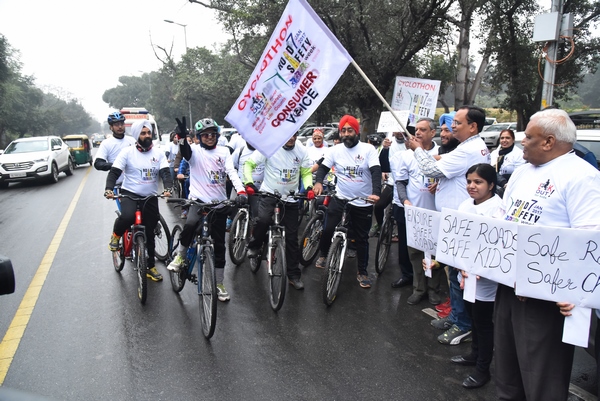
Consumer VOICE organized Cyclothon (Cycle Rally) event on January 7, 2017 on the occasion of Road Safety Week in January(11 Jan-17 Jan  2017) at Nehru Park, Neeti Marg Parking Area ,Chanakyapuri, New Delhi in association with Delhi Traffic Police.

The main objective of the event is to create awareness on road safety aspects among masses and also to make citizens aware about their duties towards road safety in India and for strong road safety law which will help in averting countless avoidable deaths due to road accidents.
The theme of the Cyclothon was 'Child Safety and Safer Roads -Every Life Counts'. 
 The "Cyclothon" was flagged off by Shri Satyender Jain, Hon'ble Transport and Health Minister, Delhi Govt.
 The event also marked the presence of Shri Jagwinder Singh, Paraolympic cyclist and more than 100 cyclists. Abhay Damle, (IRS)-Joint Secretary, Transport, Ministry of Road Transport and Highways, and senior officers from Delhi Traffic Police were also present at the event. The event was organised with support from Cycling for Environment.
 In the inaugural speech Hon'ble Transport Minister appreciated the programme and requested people to respect road users and called for strong laws for road safety.Para-olympian cyclist champion Jagwinder Singh also joined the event and  appreciated the efforts and emphasized the need for having more such events to promote road safety among citizens.
The event was attended by cyclists, students, athletes, consumer organisations,media and senior citizens who came forward to support the cause of Road Safety and Child Safety.


Facts about Child Safety :  
According to the United Nations Convention on the Rights of the Child (CRC) 1989, children be given protection and care for his/her well-being.
  • One way to achieve this goal is to prevent them from being killed on the roads.
  • In addition, one of the new Sustainable Development Goals (SDG) targets (3.6) is to halve the global number of deaths and injuries from road traffic crashes by 2020.
  • As one of the signatories to the SDGs, India has the responsibility to enact appropriate legislation to achieve this goal, especially when it comes to the safety of India's children on the roads. 
  • According to the National Crime Records Bureau (2013), 20 children under the age of 14 die every day due to road crashes in India.
  • Almost 60 children age 3 to 15 are killed or seriously injured on Indian roads. 
  • In 2014 alone, 16,901 children were killed in road crashes in India.
  • This is nearly 675% more than the reported deaths of children from all crimes against them put together.
  • Children accounted for 6.1% of the total accidental deaths due to motor vehicle crashes in 2013 in India.

Tuesday, July 26, 2016


        India’s daily death toll due to road accidents is more than four times the annual death toll from terrorism. Every person going on the road has risk of injury or death such as pedestrians, motorists, cyclists, passengers, etc. Drivers’ fault is the single most important factor responsible for accidents: Revealed by an analysis of road accident data by Ministry of Road Transport & Highways.  This highlights the fact that Government must enforce stricter road rules in India and also provide adequate infrastructure to safeguard its citizens.

If a drunken person kills another person, it is considered murder but if a drunken driver kills a whole family on the road due to negligent driving, he can get away with a minimal fine.  This is a serious lapse of law in our country.    We all know how easy it is to get a driving license in India.  We also know how easy it is to escape after a road offence in India.  RTO offices are traditionally considered to be one of the biggest centers of corruption and bribe in India. 
           
As quoted by Dr. P. Hirishikesh, Chairman of Institute of Health Systems, nobody cares for traffic rules in India; they are treated like best practices rather than compulsory.  Talking about human errors is ridiculous in India.  But which human error are we talking about?  Unless there is a grand National mindset change (or strict governance) things will remain as they are.

            At present an innocent person who is injured on the road for no fault of his has no support from the Government. The entire burden of treatment and support to the family falls on him. The Government has absolved itself of its duties and responsibilities.  This is morally not correct.  It is the fundamental duty of the Government to enforce laws and make roads safe for its citizens.

            Ministry of Road Transport and Highways initiated the Road Transport and Safety Bill (RTSB) which is expected to be presented in Parliament in the monsoon session.  The Group of Transport Ministers Conference has come up with some 30 plus recommendations to finalize changes in the 1988 Motor Vehicle Act.  One major recommendation by the GoM is stringent penal provisions for repeat offenders on grave traffic violations, by revoking the license for two years of a third time offender.  This will not only act as a deterrent but will definitely reduce the number of accidents on the roads.